
[breadcrumb]
Medical disinfectants
Medical disinfectants and hospitals –two terms that are inseparably linked in the public’s perception.
Outside of medical facilities (medical and dental practices, hospitals, retirement and nursing homes, etc.), where else is there a greater need for high-quality medical disinfectants? Indeed, ever since the discovery of antiseptics (Lister 1867), disinfectants have become indispensable in modern medicine.
Disinfection of laboratory wastewater / liquid waste
Control of biofilms, Legionella and microbiological corrosion
Depending on the bio-safety category of the microorganisms worked with in laboratories, contaminated wastewater and cell culture supernatants must be inactivated accordingly before disposal via the sewage system.
This is done in accordance with legal regulations to protect the environment from any pathogenic or genetically modified organisms. This is always done by autoclaving the waste water or by a similar thermal treatment. However, if chemical disinfection or inactivation methods can ensure a comparable effect, these can also be dispensed with.
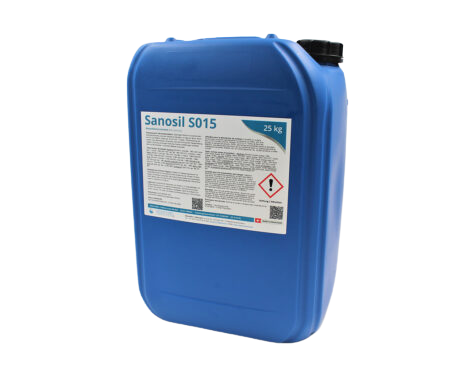
OFFICE OF WASTE DISPOSAL – LEAFLET
S015 DISINFECTION OF LABORATORY LIQUID WASTE
Disinfection / inactivation of laboratory liquid waste: Statutory regulations
The inactivation of microbiologically contaminated waste is a key aspect in minimising the escape of organisms from the laboratory and eliminating any risk to humans and the environment. The Containment Ordinance (ESV) requires as a condition that organisms must be harmlessly disposed of in the case of Class 1 activities and inactivated in the case of Class 2-4 activities.
[expander_maker id=”2″ more=”Read more” less=”Read less”]The Swiss Federal Office for Accident Prevention recommends that laboratories with BSL2 or higher dispose of liquid waste and contaminated laboratory wastewater by collecting it in suction bottles, chemically inactivating it on site and then autoclaving it.
Autoclaving may not be necessary for safety levels 1-3 if cultures, accumulations of microorganisms and any contaminated waste can be inactivated on site (levels 2 and 3) or disposed of harmlessly (level 1) by chemical inactivation with comparable effect.
Liquid waste inactivation: Individual validation of the method(s)
However, since liquid waste can vary depending on its chemical composition, number and type of microorganisms, the chosen method (with/without autoclaving, appropriate dosage and contact time, etc.) must always be validated individually. Our information on the application of Sanosil S015 for the disinfection of cell cultures and liquid waste is based on well-founded tests and practical experience, but may deviate in individual cases.
Sanosil S015 : Boosted hydrogen peroxide for disinfection of cell cultures and laboratory waste water
Sanosil S015 is a proven disinfectant for water and water system disinfection as well as inactivation of waste water and liquid waste (Pt 2.4). Sanosil S015 for the disinfection of liquid laboratory waste is relatively easy to handle: Not a hazardous material, non-flammable, does not cause foul-smelling vapours and is not subject to any special storage or transport regulations.
It can be autoclaved in application concentrations, can be disposed of via the sewage system (AWEL list cat. A) and is therefore very well suited for the chemical inactivation of liquid laboratory waste.
Hydrogen peroxide is used as the active ingredient, which is additionally stabilised and its disinfecting effect is catalytically enhanced many times over by a minimal amount of silver ions. This process can increase the disinfecting effect by up to 800%.
The hydrogen peroxide decomposes completely into water and oxygen after use and therefore pollutes the sewage treatment plants or the environment much less than e.g. quaternary ammonium compounds or aldehydes. In contrast to chlorine-containing products, no trihalomethanes / AOX are formed with Sanosil S015. This makes Sanosil S015 an ideal product for the disinfection of laboratory wastewater. [/expander_maker]
HOME AND CARE INSTITUTIONS
Children – old people’s and nursing homes, assisted living, crèches
Hygiene in residential care: nursing home cleaning products
Nursing home cleaning products as an essential part of hygiene in nursing homes is a multi-faceted topic. The prevention of infections in care facilities is among the most important daily tasks in the residential care sector. The risks associated with MRSA and other antibiotic-resistant bacteria make this task especially challenging and problematic. Even in industrialised countries, around ten times more people die from infections contracted in care facilities than from traffic accidents.
Nursing home cleaning products: Basic hygiene principles in residential care
Hygiene is the doctrine of maintaining human health. Hence the importance of color: nursing home cleaning products. In principle, all hygiene measures in care facilities are aimed at identifying, reducing, removing or at least preventing the uncontrolled spread of germs.
The risk of infection for people in residential care is decisively influenced by the individual’s immune system and the prevalent nursing, medical and hygiene in care homes-related factors. An increased risk of infection may be caused by chronic diseases, functional restrictions, immobility, wounds or clouding of consciousness.
A detailed list of all the possible and necessary steps required to implement a comprehensive hygiene concept for a care facility (such as a hospital, old people’s home or nursing home) using adequate nursing home cleaning products would fill several volumes and go far beyond the remit of this article. Nevertheless, we will examine a few basic principles and some typical hygiene regulations in the residential care industry in more detail.
[expander_maker id=”2″ more=”Read more” less=”Read less”]Hand hygiene in care homes
Despite common knowledge about the role of hands in the transmission of germs, most infections via contaminated hands are still caused by doctors, nurses, patients and visitors. Hand washing in care homes is particularly important. Although hand hygiene is taught intensively in every nursing school and the procedure is known by every member of the nursing staff, the challenge is to apply this knowledge consistently and thoroughly.
Stress, overload and staff shortages, all of which are frequent occurrences in the residential care sector, often undermine carefully planned hygiene measures. Who can honestly say that they always remember to wash and disinfect their hands carefully after a 14-hour shift?
For this reason, careful personnel planning is the first step towards implementing a successful hygiene concept.
Since the techniques for ensuring hand hygiene in nursing homes is the subject of a separate chapter, we will not discuss the details of hand disinfection in care facilities here.
In general, however, the following can be stated: hygienic hand disinfection in care facilities using nursing home cleaning products must always be carried out before and after any activity involving a risk of infection or contamination. This not only serves to protect patients, but also safeguards the health of all nursing staff. Normal social contact with patients without known infectious diseases does not require hand disinfection.
Care home cleaning and disinfection
Disinfection is a measure that places an object (including parts of the body) into a state in which it can no longer cause illness. The aim of disinfection is to reduce the number of pathogens to a safe level, i.e via eradication, inactivation, inhibition or removal of pathogenic microorganisms. Disinfection is always carried out with approved disinfectants and is a process with a standardised proof of effectiveness.
Cleaning is a process to remove impurities (e.g. dust, chemical substances, microorganisms, organic substances) through the use of water containing cleaning agents i.e. care home cleaning products, whereby the primary aim is not necessarily to kill microorganisms.
Daily, routine cleaning in nursing homes is carried out in accordance with the hygiene plan and with normal, household cleaning agents. In each case, the required nursing home cleaning procedures are specified for the respective area.
Here is a typical example of the work instructions contained in a hygiene plan for a care facility: „In the event of contamination with blood, bodily excretions or other biological substances, targeted disinfection must be carried out immediately in the affected area (e.g. floor, toilet). This means that gloves must be worn and the area generally cleaned with a paper towel before being disinfected with a wipe containing nursing home cleaning products in the form of a surface disinfectant.
Or: „Before aseptic activities (e.g. changing dressings, preparing medication, etc.) the work surface must be specifically disinfected with surface disinfectant and a wiping cloth.
Use of nursing home cleaning products during an outbreak of infection
Special measures must be taken for patients who are at increased risk of infection. In the event of outbreaks, disinfection measures must be carried out routinely and extensively. These must be detailed in advance in an action plan for emergencies and must include all affected areas, such as patients, nursing staff, visitors, external service providers (transport services, etc), the supply of cleaning agents, disinfectants and cleaning and protective equipment such as masks and gloves, disposal of infectious waste, as well as food and drink. In the ideal case, it should be possible to seal off any affected areas effectively within a short period of time, without disrupting the supply of materials needed for patient care.
Since outbreaks of infectious diseases such as noroviruses can disrupt the functioning of entire departments and facilities, as soon as they are suspected it is essential to notify everyone concerned in order to contain the epidemic. These precautionary measures must be taken as soon as two or more persons show acute signs of illness such as diarrhoea and/or vomiting (patients or staff), provided that they have recently had contact with each other. [/expander_maker]
HOSPITAL
Hospital disinfectants vs nosocomial infections
Hygiene in hospitals: the big challenge
Hospital-acquired infections (so-called nosocominal infections) are one of the biggest problems in health care. The reasons for this are manifold. The often cited neglected hygiene in hospitals due to time pressure and overwork of staff is sometimes justified, but it is not the sole reason for the increased risk of contracting a germ in a care facility. Antibiotic resistance and cross-resistance favoured by certain disinfectants such as QAV negate many of the staff’s efforts.However, it is also a fact that many of these infections can be avoided through optimal hygiene in the hospital and careful disinfection management.
Nursing home cleaning products: Basic hygiene principles in residential care
Hospital disinfectant provides for an adequate hospital hygiene. The definition of hygiene is „the science concerned with the maintenance of health“ — prophylaxis to prevent illness. As a rule, better hygiene means fewer (infectious) diseases. The problem is not a lack of knowledge, but rather the work (and costs) involved in ensuring good hospital hygiene on the one hand, and a certain „organisational blindness“ or weariness regarding continual compliance with the known hygiene standards for hospitals and doctors‘ practices on the other.
[expander_maker id=”2″ more=”Read more” less=”Read less”]However, the costs resulting from more effective hygiene standards can be recovered via the savings derived from avoiding illness in the first place. A lower risk of staff becoming infected means fewer absences due to sickness. In addition, having a lower risk of infection compared to other hospitals will boost a clinic’s reputation, making it more attractive to private patients in particular.
Hospital hygiene: definition and concept
Hospital hygiene is defined as the medical specialisation in researching and implementing specific hygiene measures in hospitals that provide inpatient and outpatient care. This includes medical practices which perform outpatient surgery. Hospital hygiene includes procedures derived from precautionary measures for patients and personnel safety guidelines (occupational safety and accident prevention).
A hygiene concept is primarily about selecting a range of interlocking measures for all wards to improve hygiene at the hospital. The sequence for developing a concept (analyse, evaluate, define measures, implement, monitor) and assuring quality (plan, do, check, act) helps to create a suitable structure for the hygiene concept.
To begin with, an analysis of the critical points and weaknesses in the current hygiene concept is performed, much like with an HACCP concept. In the second stage, the findings help to evaluate preventive measures, hygiene guidelines and procedures for decontamination (sterilisation, disinfection with hospital disinfectant, antiseptics, ventilation and air conditioning, etc) and to begin developing and evaluating quality assurance methods.
Hospital hygiene using hospital disinfectant : legal requirements and directives
Every country has legal requirements, which should be consulted when developing the concept. In Germany, for example, the Protection Against Infection Act (IfSG) forms the legal basis for hygiene measures in hospitals, while in Switzerland the Epidemics Act accomplishes the same objective. The Committee for Hospital Hygiene and Preventing Infection (KRINKO) at the Robert Koch Institute (RKI) issues recommendations with steps to ensure hospital hygiene on a regular basis.
In Switzerland, Swissnoso – the National Centre for Preventing Infection – is the authority and competent partner when optimising hospital hygiene and combating nosocomial infections. The network coordinates actions and collects cases for statistical purposes. The Robert Koch Institute performs this task for Germany. In particular, it is known for the RKI Disinfectants List, which includes hospital disinfection products tested for disinfecting in hospitals. It also lists certain cleaning agents and disinfectant cleaners i.e. hospital disinfectant cleaner.
Practical hospital hygiene tips: hands
It is tragic that, despite Semmelweis’s insights into the importance of hand hygiene in hospital settings, a large share of nosocomial infections are still caused by contaminated hands.
The WHO Guidelines on Hand Hygiene in Health Care: a Summary. WHO, 2009, recommend:
Hand hygiene with alcohol-based hand rub
Applications: for routine disinfection before and after direct contact with a patient.
Duration: 30 seconds.
It is important to moisturise the hands regularly, as regular contact with alcohol-based hand disinfectants can dry out and chap the skin.
Appropriate hospital hand disinfectant must be used.
Hand hygiene with water and soap (washing hands)
Applications: when hands are visibly contaminated, such as with blood or other bodily fluids. After using the toilet.
Duration: 40 to 60 seconds.
Touchless taps and mild liquid soap from a sensor dispenser as well as disposable towels are mandatory to prevent hands from becoming recontaminated after washing.
Training and inspections
Although every hospital employee is aware of the importance of hand hygiene, stress, routine, demotivation and plain forgetfulness can lead to a gradual desensitisation around the issue. Therefore, it is important to maintain an inspection body separate from the usual hierarchy which inspects hygiene at the hospital on a regular basis and provides feedback. Swab samples can be taken in periodic spot checks, for example. It has proven effective for different or even competing clinics and hospitals to inspect each other.
Practical hospital hygiene tips: surfaces
Secondary surfaces (e.g. floors, walls, etc): these should be treated with suitable surface cleaners, with added hospital floor disinfectant if required. Important: it is mandatory to use a cleaning system which prevents pathogens from being distributed. A mopping system such as Vileda Sweep System instead of the out-dated mop-and-bucket method is ideal for optimal hospital hygiene. The latest trends and studies from Scandinavia (like the Freiburg method) take this a step further and advocate dry cleaning using dust-binding microfibre pads. Dry cleaning has proven to be a functional alternative or supplement for hospital hygiene which merits further consideration.
Primary surfaces / contact surfaces (e.g. keyboards, door handles, phones, touch screens, handles, etc) Wipe/disinfect with a hospital disinfectant from the RKI List and a disposable wipe.
The risk of resistances developing (especially a problem in large hospitals) makes it advantageous to combine systems with different effects or use alternating hospital disinfectants with different mechanisms (e.g. oxidising disinfectants).
Fumigation: To further optimise hygiene, as well as during outbreaks and to prevent resistant pathogens, it is advisable to carry out additional aerosol disinfection hospital using the Sanosil Q-Jet system in order to ensure adequate coverage of all surfaces in the contaminated area.
This type of system is the future of hospital hygiene. [/expander_maker]
3D-ROOM DISINFECTION
Devices and agents for surface and air disinfection by aerosols
The disinfection method of the future
Aerosol disinfection: Here, disinfectant is automatically blown into the air as a mist using a automatic device. This mist settles on the surfaces and disinfects them. It is the most modern method of surface disinfection. It closes gaps in the effectiveness of manual surface disinfection and is establishing itself as an important instrument in the fight against, among other things, antibiotic-resistant germs.
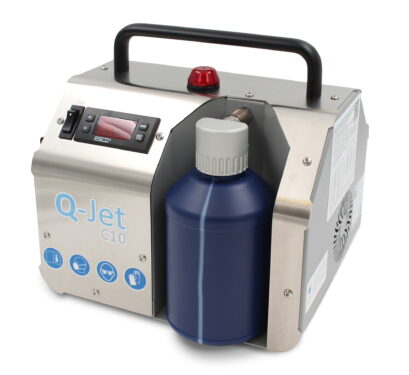
Q-JET C10
Aerosol disinfection through automated airborne system.
Compressor technology, ideal for vehicles and small rooms.
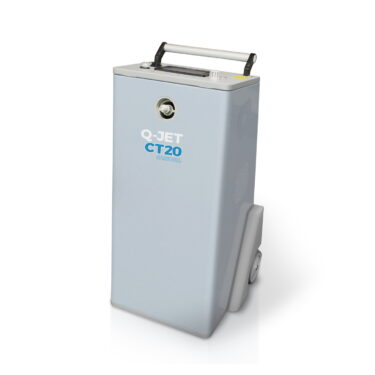
TESTIMONIAL IVI (BSL 4 LABORATORY)
TESTIMONIAL Q-JET VS. CORONAVIRUS (EN-DE)
Q-JET C10
Q-JET CT20
Aerosol disinfectant — perfect for disinfecting?
Aerosols are tiny liquid droplets which get sprayed into the air, and are primarily used as an aerosol disinfectant spray. Aerosol technology is also used in painting, the application of a range of protective agents and lubricants, as well as in nasal, room and hairsprays. But it is disinfection with a dry fogger and suitable disinfectant which represents a very special technology.
Delve deeper into the topic of surface, air and room disinfection with fogging machines, and discover the numerous advantages and special properties of aerosol disinfection.
What is aerosol disinfection?
This is a modern and practical disinfection method, which supplements the classic spray/wipe disinfection to ensure the air and surfaces in medical, food preparation, and commercial rooms is as germ-free as possible.
Unlike conventional methods, it also disinfects the ambient air.
SURFACE DISINFECTION (WIPE)
Surface Disinfection With Spray & Wipe Application
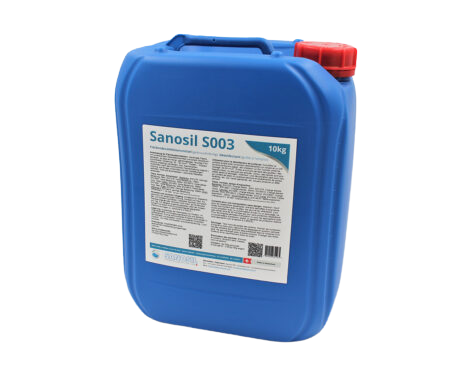
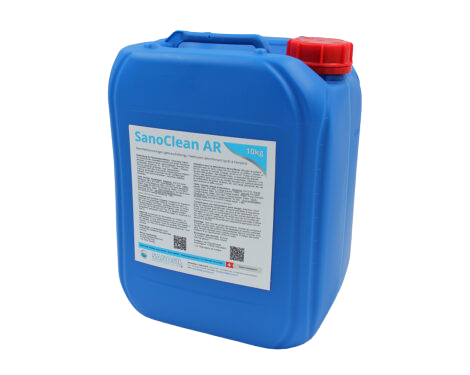
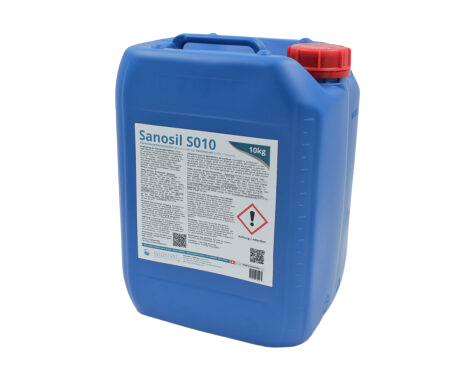
Sanosil S010
Sporicidal special disinfectant
for heavily contaminated / organically
contaminated surfaces
PHARMA SECTOR
Hygiene in laboratory and production
Medicine, Pharmaceutical Industry and Laboratory Disinfectants from Sanosil
Laboratory disinfectants are necessary just like they are in the food industry e.g. Research laboratories, medical institutes and the pharmaceutical industry are subject to stringent hygiene regulations. Either because they deal explicitly with microorganisms or because contamination could have disastrous results. This text cannot cover laboratory hygiene measures exhaustively, and is instead intended to provide a brief overview.
Sanosil S010
Sporicidal special disinfectant
for heavily contaminated / organically
contaminated surfaces
The significance of the lab hygiene plan for professional cleaning and disinfection using laboratory disinfectants
Laboratory disinfectants should be a part of a hygiene plan.The existence of and compliance with a hygiene plan serves to ensure personal safety and protect health. The hygiene plan reflects the awareness that infectious microorganisms must be handled with caution. Its consistent implementation prevents potentially dangerous pathogens from escaping into the environment.
In addition, from an environmental perspective, the appropriate use of detergents and a lab disinfectant should be considered. For these reasons, it must be possible to document both the existence of a hygiene plan and its implementation when regulatory authorities carry out inspections.[expander_maker id=”2″ more=”Read more” less=”Read less”]
General recommendations for using laboratory disinfectants
Never apply laboratory disinfectants without cleaning first (exception: using disposable wipes which combine detergent and disinfectants used in pharma)
Only use cold water to create a lab disinfectant solution (to avoid vapour which irritates the mucosa).
Ensure the correct dosage or concentration for application of a disinfectant lab microbiology.
Always wear protective gloves when cleaning or disinfecting (to prevent allergies developing) with disinfectants used in pharmaceutical industry.
Where possible, wipe instead of spray – always try to prevent cross-contamination
Observe exposure times / contact times.
After wiping down areas with laboratory disinfectants, only use them once the disinfectants in laboratories have dried.
Creating a hygiene plan for cleaning and disinfecting in pharmaceutical / laboratory settings
The hygiene plan is the relevant instrument for standardising all hygiene measures in the laboratory. To create a hygiene plan, it is advisable to identify critical points in the system and target them with countermeasures, much like an HACCP concept does.
This way, many sources of contamination can be eliminated with laboratory disinfectants via organisational measures designed to prevent contamination and the spread of microorganisms; for example, by changing shoes or establishing hygiene locks.
Example of a plan containing hygiene measures in laboratories and pharmaceutical settings
The following questions provide structure and are well-suited for a laboratory hygiene plan.
WHAT: area, device, item, instrument
WHEN: how often, at which time
WITH WHAT: which lab disinfectant / detergent, sanitizing agents in pharmaceuticals, equipment
HOW: application, cleaning method
OTHER: particulars, special information
Example:
What: side table in lab room 512, surface
When: after each use
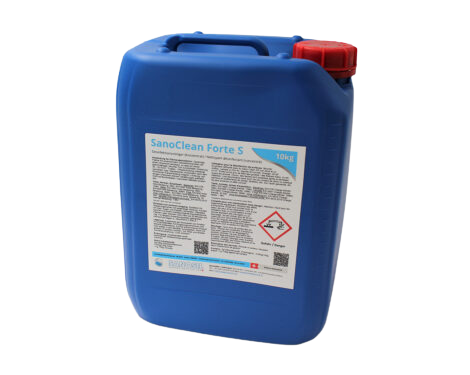
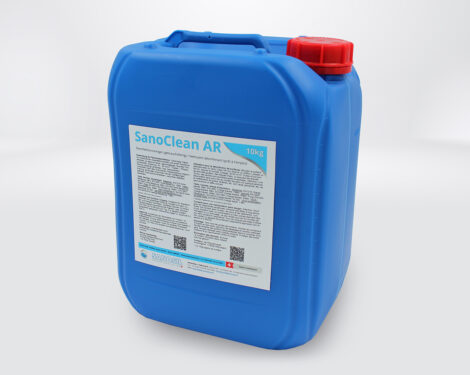
With what: SanoClean AR disinfectants used in microbiology laboratory, undiluted
How: ready-to-use damp disposable wipe, wipe down surface thoroughly. Do not rinse
Other: not a substitute for thorough weekly cleaning.[/expander_maker]
Medical disinfectants
When Sir Joseph Lister first used phenol in the 1860s to disinfect surgical materials at his hospital, he had no idea that the use of medical disinfectants would revolutionise medicine. Through the use of carbolic acid, which had previously been used successfully as a disinfectant in the wastewater sector, he managed to reduce the infection rate among his patients from 50 to 15 per cent.
Some years earlier, Ignatz Semmelweis had discovered the importance of hand disinfection in hospitals using chlorinated lime solution as a disinfectant. However, he was strongly opposed by his medical colleagues, who dismissed his theories about microorganisms and the impact of unwashed hands on patients‘ health and survival rates as absurd. After all, had he been right, it would have meant that the doctors themselves had caused the death of countless patients… [expander_maker id=”2″ more=”Read more” less=”Read less”]
Later, the work of important microbiologists like Robert Koch provided the decisive breakthrough in the field of medical microbiology. And this, in turn, brought about a widespread search for suitable medical disinfectants, because specific applications require very different disinfecting substances.
Medical disinfectants: requirements and intended use
It was discovered early on that, in hospitals for example, different medical disinfectants are required for hand disinfection and surface disinfection. In a doctor’s surgery, the requirements for instrument disinfection or sterilization of dental instruments are different to those for floor disinfection. Equally, skin disinfection before surgical procedures should not be confused with disinfection of wounds.
A rough distinction is therefore made between:
Surface disinfectants (including aerosol disinfectants)
Water disinfectants
Disinfectants used in hospitals for laundry
Instrument disinfectants / machine disinfectants
Hand sanitisers
Skin disinfectants
Wound disinfectants
When purchasing a medical disinfectant, it is therefore essential to pay attention to the intended use. Using unsuitable disinfectants may not only result in reduced effectiveness, but also in material damage (e.g. through corrosion). For example, hand sanitisers are largely unsuitable for floor disinfection in a doctor’s surgery, unlike the adequate hospital cleaning disinfectants. Equally, a disinfectant designed for surgical instruments is no good for skin disinfection.
Disinfectants in the medical sector: effectiveness
As well as the requirements for the intended use of medical disinfectants, they also differ in terms of their properties. Not only do these agents differ in terms of the required exposure time, but it must also be determined whether the respective certificate of suitability or suitability test report was issued in accordance with a standardised procedure (EN test) and with or without an organic load. The following efficacy levels are usually advertised for medical disinfectants:
Bactericide: effective against bacteria EN 13727 / EN 13697
Fungicide, levurocide: effective against fungi and yeasts EN 13624 / EN 13697
Mycobactericide: effective against mycobacteria EN 14348
Sporicide: effective against bacterial endospores EN 13704
Tuberculocide: effective against Mycobacterium terrae (tuberculosis) EN 14348
Virucide: effective against viruses EN 14476
When choosing hospital disinfectants etc, therefore, the range of effects must also be taken into account in addition to the intended use. Effective and safe types of disinfectants used in hospitals and medical practices can only be ensured via careful coordination of the disinfectant’s intended use, effectiveness, type of application and exposure time. [/expander_maker]
Hospital Hygiene V1.2
Leaflet chemical inactivation
Sanosil List of Authorization